Thursday, October 29, 2026

How To Build Marketplaces Of Any Flavor With Martsi

Launching your own marketplace sounds exciting until you realize you are not building a normal website. A real marketplace has to serve two completely different groups at the same time. Sellers need accounts, dashboards, listings, orders, payouts, reviews, messaging, and enough control to run their businesses.

Buyers need search, product pages, checkout, payment options, order tracking, support, and confidence that the platform is trustworthy. Then the marketplace owner needs commissions, moderation, disputes, SEO, analytics, vendor management, and the ability to keep the whole system running without manually processing every transaction.

Martsi is a cloud-based multi-vendor marketplace platform created by Cyril Gupta and Teknikforce. Its purpose is to let you launch an online marketplace without developing the underlying technology yourself. Instead of being the only seller, you can invite independent vendors onto your platform. Those vendors can create listings and sell through the marketplace while you manage the ecosystem.

Martsi supports several marketplace models, including physical products, digital products, services, and rentals. That flexibility immediately gives the software more possibilities than a standard ecommerce builder. You could create a niche marketplace for handmade products.

  • Create and manage your marketplaces
  • Watch every marketplace from one dashboard
  • Run each marketplace from its admin
  • Manage buyers and sellers
  • Your public storefront
  • Listing pages that sell
  • Approve and feature listings
  • Sellers get their own panel

This is the part that matters most and gets the least space on the sales page. From the demo and the FAQ, here’s how an order works:

  1. A buyer checks out through the gateway you connected (Stripe, PayPal or Razorpay), so the payment lands in your gateway account.
  2. Martsi records your platform fee (commission, flat fee, or both) and the seller’s earnings.
  3. Earnings unlock after your payout lock period, and the seller can request a payout once they reach your minimum.
  4. Martsi “reports the payments you need to make to your sellers”, and you send them.

That’s a perfectly workable model, and it’s how many small marketplaces start. But it means you hold sellers’ money for a while and you’re responsible for paying them on time. Depending on your country, that can raise tax and payments-regulation questions, so speak to an accountant before you scale. If you need automatic split payments (like Stripe Connect on Sharetribe), ask Teknikforce support before you buy.

Martsi gives you the software. These 25 tools cover everything around it that decides whether a marketplace works: picking a niche that can succeed, setting fees sellers accept, recruiting and onboarding your first sellers, writing policies, handling disputes and payouts, planning SEO and email, and pricing client and reseller work. Every one is a working browser tool, not an ebook. They run on desktop or phone, and nothing you type leaves your device.

Source: Martsi Marketplace

.

Martsi,MarketplaceCreator ,CreatorEconomy ,OnlineMarketplace ,SellOnline ,DigitalMarketplace ,Entrepreneur ,ContentCreator ,Ecommerce ,BusinessGrowth ,MonetizeYourContent ,MarketplacePlatform ,Innovation ,CreativeEntrepreneur ,SmallBusiness ,SelfMade ,MakeMoneyOnline ,StartYourOwnBusiness ,SideHustle ,PassiveIncome ,EconomicEmpowerment

Gigantic Iceberg Breaks Free In Antarctica, Revealing Ghostly Mega Nest Beneath

The scientists were on expedition in the Weddell Sea looking for Sir Ernest Shackleton’s lost ship, the Endurance which sank in 1915 and was discovered in 2022 – when they found the nesting grounds in a remote area which had, until recently, been underneath a large ice shelf.  When the 5,800-square-kilometre A68 iceberg calved from the Larsen C Ice Shelf, scientists were finally able to access the seabed beneath. It wasn’t easy. “As with a lot of Antarctic research we battled the cold, sieving freezing cold mud on the back deck for hours,” says Dr Michelle Taylor, head of science at Ocean Census.…….Continue reading….

By: Melissa Hobson

Source:  Discover Wildlife

.

Critics: 

An iceberg may flip, or capsize, as it melts and breaks apart, changing the center of gravity. Capsizing can occur shortly after calving when the iceberg is young and establishing balance. Icebergs are unpredictable and can capsize anytime and without warning. Large icebergs that break off from a glacier front and flip onto the glacier face can push the entire glacier backwards momentarily, producing ‘glacial earthquakes’ that generate as much energy as an atomic bomb.

Icebergs are generally white because they are covered in snow, but can be green, blue, yellow, black, striped, or even rainbow-colored. Seawater, algae and lack of air bubbles in the ice can create diverse colors. Sediment can create the dirty black coloration present in some icebergs. In addition to size classification (Table 1), icebergs can be classified on the basis of their shapes. The two basic types of iceberg forms are tabular and non-tabular.

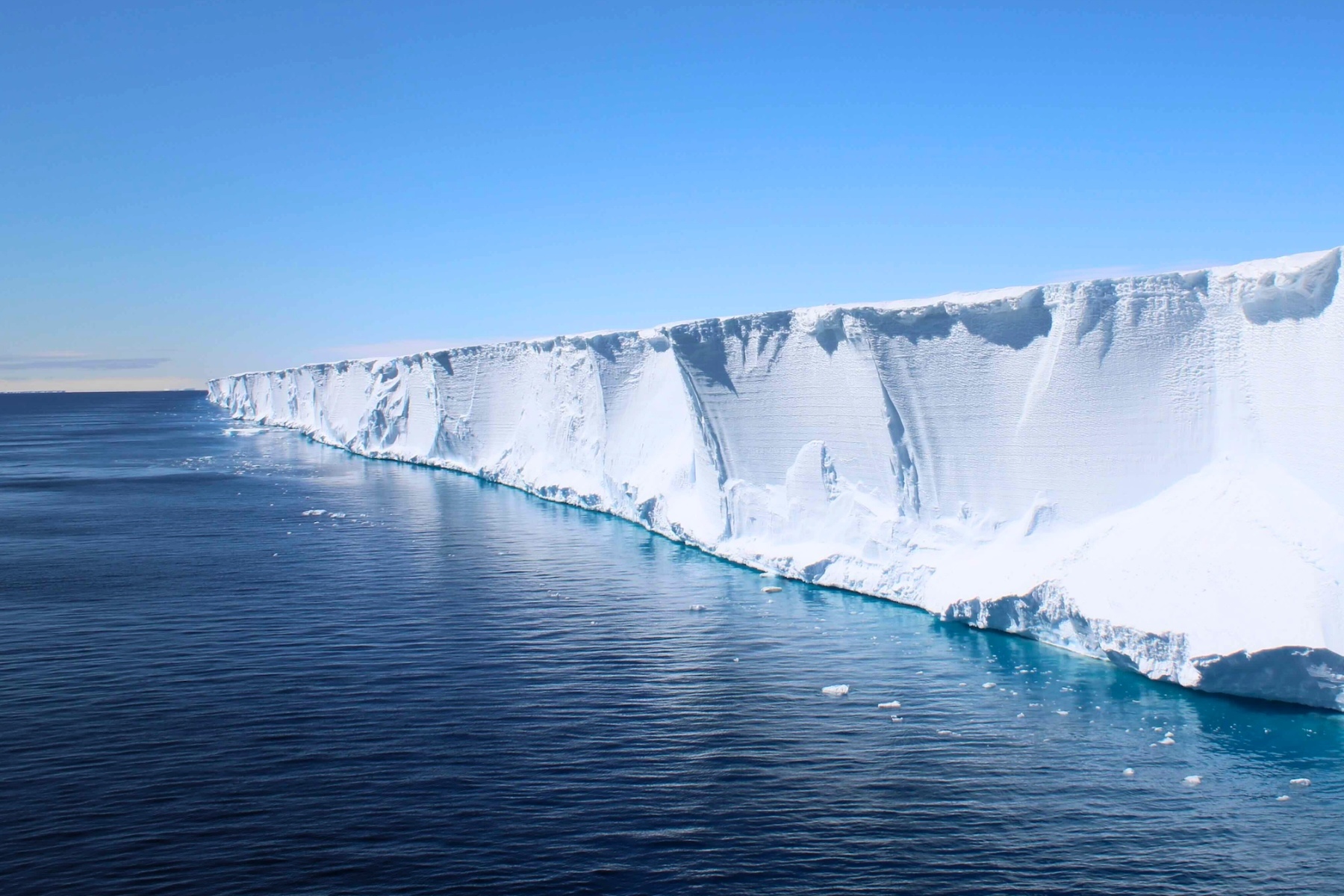
Tabular icebergs have steep sides and a flat top, much like a plateau, with a length-to-height ratio of more than 5:1. This type of iceberg, also known as an ice island, can be quite large, as in the case of Pobeda Ice Island. Antarctic icebergs formed by breaking off from an ice shelf, such as the Ross Ice Shelf or Filchner–Ronne Ice Shelf, are typically tabular. The largest icebergs in the world are formed this way.

Non-tabular icebergs have different shapes and include:

  • Dome: An iceberg with a rounded top.
  • Pinnacle: An iceberg with one or more spires.
  • Wedge: An iceberg with a steep edge on one side and a slope on the opposite side.
  • Dry-dock: An iceberg that has eroded to form a slot or channel.
  • Blocky: An iceberg with steep, vertical sides and a flat top. It differs from tabular icebergs in that its aspect ratio, the ratio between its width and height, is small, more like that of a block than a flat sheet.

Prior to 1914 there was no system in place to track icebergs to guard ships against collisions despite fatal sinkings of ships by icebergs. In 1907, SS Kronprinz Wilhelm, a German liner, rammed an iceberg and suffered a crushed bow, but she was still able to complete her voyage. The advent of watertight compartmentalization in ship construction led designers to declare their ships “unsinkable”.

During the 1912 sinking of the Titanic, the iceberg that sank the Titanic killed more than 1,500 of its estimated 2,224 passengers and crew, seriously damaging the ‘unsinkable’ claim. For the remainder of the ice season of that year, the United States Navy patrolled the waters and monitored ice movements. In November 1913, the International Conference on the Safety of Life at Sea met in London to devise a more permanent system of observing icebergs. Within three months the participating maritime nations had formed the International Ice Patrol (IIP).

The goal of the IIP was to collect data on meteorology and oceanography to measure currents, ice-flow, ocean temperature, and salinity levels. They monitored iceberg dangers near the Grand Banks of Newfoundland and provided the “limits of all known ice” in that vicinity to the maritime community. The IIP published their first records in 1921, which allowed for a year-by-year comparison of iceberg movement.

Aerial surveillance of the seas in the early 1930s allowed for the development of charter systems that could accurately detail the ocean currents and iceberg locations. In 1945, experiments tested the effectiveness of radar in detecting icebergs. A decade later, oceanographic monitoring outposts were established for the purpose of collecting data; these outposts continue to serve in environmental study.

A computer was first installed on a ship for the purpose of oceanographic monitoring in 1964, which allowed for a faster evaluation of data. By the 1970s, ice-breaking ships were equipped with automatic transmissions of satellite photographs of ice in Antarctica. Systems for optical satellites had been developed but were still limited by weather conditions. In the 1980s, drifting buoys were used in Antarctic waters for oceanographic and climate research. They are equipped with sensors that measure ocean temperature and currents.

Side looking airborne radar (SLAR) made it possible to acquire images regardless of weather conditions. On November 4, 1995, Canada launched RADARSAT-1. Developed by the Canadian Space Agency, it provides images of Earth for scientific and commercial purposes. This system was the first to use synthetic aperture radar (SAR), which sends microwave energy to the ocean surface and records the reflections to track icebergs.

The European Space Agency launched ENVISAT (an observation satellite that orbits the Earth’s poles) on March 1, 2002. ENVISAT employs advanced synthetic aperture radar (ASAR) technology, which can detect changes in surface height accurately. The Canadian Space Agency launched RADARSAT-2 in December 2007, which uses SAR and multi-polarization modes and follows the same orbit path as RADARSAT-1.

The freshwater injected into the ocean by melting icebergs can change the density of the seawater in the vicinity of the iceberg. Fresh melt water released at depth is lighter, and therefore more buoyant, than the surrounding seawater causing it to rise towards the surface. Icebergs can also act as floating breakwaters, impacting ocean waves.

Icebergs contain variable concentrations of nutrients and minerals that are released into the ocean during melting. Iceberg-derived nutrients, particularly the iron contained in sediments, can fuel blooms of phytoplankton. Samples collected from icebergs in Antarctica, Patagonia, Greenland, Svalbard, and Iceland, however, show that iron concentrations vary significantly, complicating efforts to generalize the impacts of icebergs on marine ecosystems.

In the last month

How To Battle Boredom At Work

Vladimir Vladimirov/E+ via Getty Images

Though neuroscience suggests that boredom can be good for us, we all try to avoid it. Even the most exciting jobs in the world — astronaut, nuclear engineer, helicopter pilot, virus hunter — can be filled with drudgery at times. Nobody is immune from paperwork and meetings. The problem with boredom at work is that its negative effects can linger. You might be able to power through a mind-numbing task, like putting stamps on 500 envelopes, but in doing so you harm your ability to accomplish subsequent tasks. Suppressing boredom doesn’t prevent its effects; it simply places them on hold until later………Story continues…

Source: TheConversation

.

Critics:

It’s natural to feel bored at work sometimes. Everyone has days where they feel distracted or bored. However, if this happens every day for you, it may be a sign to rethink your current position. Burnout comes with cynicism, detachment, and a sense of ineffectiveness or failure. Unlike boredom, which stems from a lack of activity, burnout is the result of too much activity without sufficient rest or balance.

It really depends on you, if you would really benefit from leaving the job then by all means do it. But leaving high-paying job is a big decision and would impact you financially. So you thoroughly need to decide if it is worth it or if you can survive your boredom by trying to do more or engage more with others. Maybe your job is boring. Or it’s so busy you can’t keep up with the demands. In these situations, you need a lot of energy to stay focused.

This can lead to fatigue and job burnout. Statements like “I feel like there is more I can do like to meet clients and I feel ready to start” will get you what you want. Using positive language leads the conversation to the direction you desire. Your boss will feel confident about assigning more tasks to you without any hesitation. There are many reasons people lose and lack motivation at work.

It may be due to a change in external motivators — e.g., a reduction in pay — or decreased intrinsic motivation, where you’re fighting negative thoughts and can barely make yourself focus on what you have to do. Feeling bored with life can actually be a side effect of having unrealistic expectations. Many of us have the feeling that our lives should be continually full of adventure or plans with friends and loved ones. We don’t often value quiet reflection or moments of peace.

It is okay to quit a job you hate. Just be sure you can pinpoint why you hate it. Consider if there is anything that could improve it. Then take action – see what’s out there. Ask yourself– is it possible that this job is not for you? If you’re still feeling overwhelmed and unhappy, consider if the stress of the job is affecting the way you feel about work all together. Do some soul searching. It’s worth considering other options because maybe it is time to move on.

While it’s normal to feel tired after a long day or exercising, most people start to experience a decline in energy levels in their mid-thirties. However, feeling constantly exhausted is not normal, regardless of your age. It’s normal to feel tired or have less energy after work. However, if you’re experiencing chronic fatigue, even after getting enough sleep, you should seek help from a medical or mental health professional.

Some common causes of workplace stress and exhaustion are: Too much work. Working on tasks that no longer challenge you. High expectations without appropriate resources.How do you get through work when it’s boring? Set small goals: Break down your tasks into smaller, manageable goals. Learn something new: Use your downtime to learn a new skill or deepen your knowledge in a particular area. Organize your workspace: Use the time to declutter and organize your workspace.

Burnout comes with cynicism, detachment, and a sense of ineffectiveness or failure. Unlike boredom, which stems from a lack of activity, burnout is the result of too much activity without sufficient rest or balance.With a boreout, you get stuck in your ‘comfort zone’ for too long, until your personal development comes to a halt.” Burnout is when you are overstimulated, and boreout is when you are understimulated. Both leave you exhausted, feeling empty, and unable to cope with the demands of work and life.

You may feel that you are on your own, lose your sense of purpose, and feel increasingly cynical, dissatisfied, and incapable. Physical burnout symptoms: You may feel greatly fatigued and without energy. You may get sick often, have body aches and recurring headaches, lose your appetite, or experience insomnia & Feel drained. Not feel able to cope. Not be able to sleep. Be sad, angry, irritable or not care.

Hating your job can lead to chronic stress and other mental health issues like anxiety or depression. Insomnia, irritability, and burnout can also occur. Long-term stress can also lead to physical symptoms like headaches, muscle tension, gastrointestinal issues, or elevated blood pressure. f you are feeling burned out and need time to relax—a mental health day can be the most appropriate step to take. A personal day off can hit the reset button necessary to recharge energy levels. Some company policies permit such days off without specified reasons.

Crypto ETF Rules In The US: How a Fund Gets Listed Now

Getty Images The September 2025 approval changed the arithmetic for every crypto fund sponsor in the country. Before that date, each new cry...