Showing posts with label GrowthStocks. Show all posts

Sunday, November 15, 2026

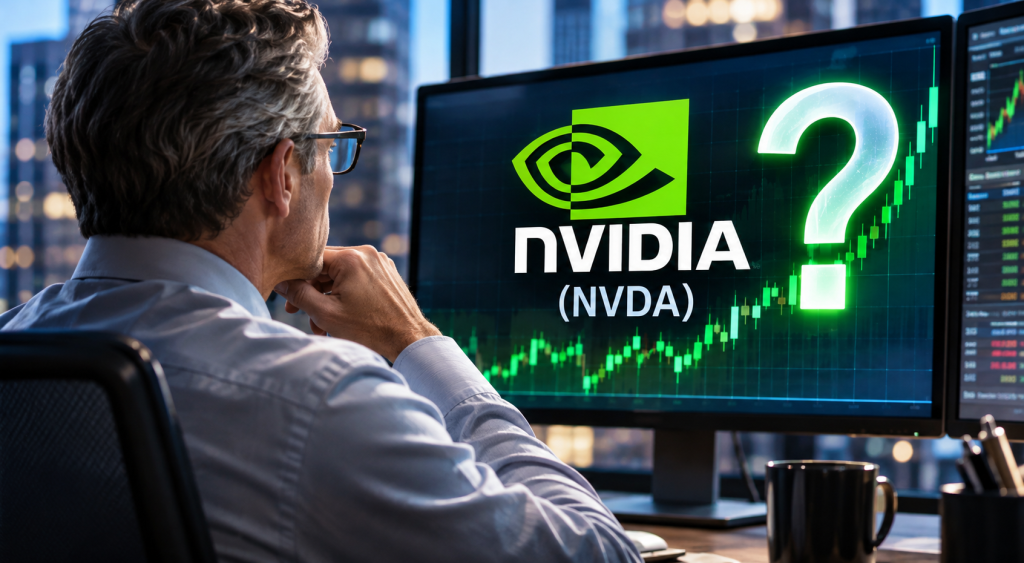
Nvidia Stock Scandal: 4 Experts on NVDA’s Future

NVIDIA Corporation (NVDA) is facing a new test after co-founder Jensen Huang resigned as chief executive amid a personal-conduct scandal and national-security questions. For shareholders, the immediate issue is whether the leadership shakeup changes the company’s earnings outlook, competitive position or the price investors are willing to pay for its growth. Jonathan Rose isn’t waiting for the dust to settle. During his November 12 Masters in Trading: LIVE,………Continue reading….

By: InvestorPlace Staff

Source:  InvestorPlace

.

Critics:

Nvidia is a software and fabless company which designs and supplies graphics processing units (GPUs), application programming interfaces (APIs) for data science and high-performance computing, as well as system on a chip units (SoCs) for the mobile computing and automotive market. Nvidia’s specialization means it is able to charge a premium for its products.

In fact, its chips, which are manufactured in Taiwan, are so unique that companies looking to build AI capabilities are complaining that there is a shortage of them. The ownership structure of Nvidia (NVDA) stock is a mix of institutional, retail and individual investors. Approximately 35.48% of the company’s stock is owned by Institutional Investors, 3.93% is owned by Insiders and 60.59% is owned by Public Companies and Individual Investors.

According to supply chain data estimates from Bloomberg, Arcuri is spot on with Microsoft being Nvidia’s largest customer. Nvidia stock fell sharply Tuesday, trading at its lowest level since late May as the market awaits Big Tech earnings and looks at potential competition in AI hardware. Nvidia shares closed down 7% at $103.73. The tech-heavy Nasdaq Composite Index dropped 1.3%.

The top individual shareholders of Nvidia are Jen-Hsun (“Jensen”) Huang, Mark A. Stevens, and Tench Coxe. The top institutional shareholders are Vanguard Group Inc., BlackRock Inc. (BLK), and FMR LLC. Nvidia stock has gained 3,776% since the start of 2019 as the company benefits from selling the main chip necessary for artificial intelligence work, minting many new multimillionaires in the process.

The main issue is that Nvidia’s graphics processing units, even its popular H100s, don’t have enough memory to handle the immense amount of video data needed to train these models, founders of AI video startups tell me. Nvidia designs and manufactures GPUs for gaming, cryptocurrency mining, and professional applications, as well as chip systems for use in vehicles, robotics, and other tools.

Today, data center processors for analytics and AI have quickly become Nvidia’s largest source of revenue, surpassing the company’s historical main business line of GPUs (graphic processing units). Nvidia Overtakes Microsoft as World’s Most Valuable Company Nvidia Overtakes Microsoft as World’s Most Valuable Company. Nvidia has become the most valuable company in the world after its market capitalization grew to $3.34 trillion, overtaking Microsoft at $3.32.

 In 2023, companies like Meta, Oracle, and Microsoft signaled their interest in AMD GPUs as a more cost-effective solution and a way to avoid a potential vendor lock-in with dominant Nvidia. AMD’s Instinct MI300 series, for example, is considered a viable alternative for scientific computing and AI uses. Concerns over Nvidia’s valuation seems to be the chief reason behind recent heavy selling. Even now, Nvidia shares on an elevated forward price-to-earnings (P/E) ratio of 43.6 times.

This remains far ahead of an average of 25.5 times for S&P 500 shares. Bank of America analyst Vivek Arya noted Nvidia is one of the firm’s top “rebound” picks amid what he expects to be a comeback for semiconductors to end 2024. “Our base case remains for a [semiconductor] rebound likely in Q4 as seasonal headwinds dissipate,” Arya wrote in a note to clients.

World’s most important fuel of the AI frenzy, NVIDIA, is facing accusations of acting as a “GPU cartel” and controlling supply in the data center market, according to statements made by executives at rival chipmaker Groq and former AMD executive Scott Herkelman. Reports claiming that Nvidia (NASDAQ:NVDA) is buying Xbox from Microsoft (NASDAQ:MSFT) have been debunked as an April Fool’s Day prank from TweakTown.

The “Nvidia buys Xbox” post spread online and started trending on some social media websites. A $20,000 investment made in the semiconductor giant 10 years ago would be worth more than $3.4 million today — up by around 170 times in value. It is also worth noting that the company has taken less than a decade to turn a $20,000 investment into precisely a $1 million.

The ownership structure of Nvidia (NVDA) stock is a mix of institutional, retail and individual investors. Approximately 35.48% of the company’s stock is owned by Institutional Investors, 3.93% is owned by Insiders and 60.59% is owned by Public Companies and Individual Investors.

The AI Chip Behind Nvidia’s Supersonic Stock RallyBNN Bloomberg 22:14
.
NvidiaStocks ,Nvidia ,StockMarket ,Investing ,TechStocks ,Finance ,WallStreet ,Trading ,BusinessNews ,StockTips ,InvestSmart ,MarketAnalysis ,InvestmentStrategy ,GrowthStocks ,Innovation,GPU ,TechInvestment ,FinancialFreedom ,MarketTrends ,BuyHoldSell

Sunday, May 24, 2026

Why The Cheapest Software Stocks May Be The Most Dangerous Bargain In 2026 

Back in 2015, a certain kind of stock looked irresistible… Tilly’s (TLYS) was trading at a single-digit P/E. So was Abercrombie & Fitch (ANF). American Eagle (AEO). The Buckle (BKE). A whole shelf of mall-based apparel names had been bludgeoned by Amazon (AMZN), and bargain hunters were lining up to scoop them out of the discount bin. The pitch wrote itself. Real revenue. Real stores. Real dividends. And a multiple that left almost nothing to the downside…….Continue reading….

By: Luke Lango

Source:  InvestorPlace

.

Critics:

The stock market is one of the most important ways for companies to raise money, along with debt markets which are generally more imposing but do not trade publicly. This allows businesses to be publicly traded, and raise additional financial capital for expansion by selling shares of ownership of the company in a public market.

The liquidity that an exchange affords the investors enables their holders to quickly and easily sell securities. This is an attractive feature of investing in stocks, compared to other less liquid investments such as property and other immoveable assets. History has shown that the price of stocks and other assets is an important part of the dynamics of economic activity, and can influence or be an indicator of social mood.

Therefore, central banks tend to keep an eye on the control and behavior of the stock market and, in general, on the smooth operation of financial system functions. Financial stability is the raison d’être of central banks. Exchanges also act as the clearinghouse for each transaction, meaning that they collect and deliver the shares, and guarantee payment to the seller of a security.

This eliminates the risk to an individual buyer or seller that the counterparty could default on the transaction. The smooth functioning of all these activities facilitates economic growth in that lower costs and enterprise risks promote the production of goods and services as well as possibly employment. In this way the financial system is assumed to contribute to increased prosperity, although some controversy exists as to whether the optimal financial system is bank-based or market-based.

Recent events such as the Global Financial Crisis have prompted a heightened degree of scrutiny of the impact of the structure of stock markets (called market microstructure), in particular to the stability of the financial system and the transmission of systemic risk. A transformation is the move to electronic trading to replace human trading of listed securities.

Changes in stock prices are mostly caused by external factors such as socioeconomic conditions, inflation, exchange rates. Intellectual capital does not affect a company stock’s current earnings. Intellectual capital contributes to a stock’s return growth. The efficient-market hypothesis (EMH) is a hypothesis in financial economics that states that asset prices reflect all available information at the current time.

The ‘hard’ efficient-market hypothesis does not explain the cause of events such as the crash in 1987, when the Dow Jones Industrial Average plummeted 22.6 percent—the largest-ever one-day fall in the United States. This event demonstrated that share prices can fall dramatically even though no generally agreed upon definite cause has been found: a thorough search failed to detect any ‘reasonable’ development that might have accounted for the crash.

It seems also to be true more generally that many price movements (beyond those which are predicted to occur ‘randomly’) are not occasioned by new information; a study of the fifty largest one-day share price movements in the United States in the post-war period seems to confirm this. A ‘soft’ EMH has emerged which does not require that prices remain at or near equilibrium, but only that market participants cannot systematically profit from any momentary ‘market anomaly‘.

Psychological research has demonstrated that people are predisposed to ‘seeing’ patterns, and often will perceive a pattern in what is, in fact, just noise, e.g. seeing familiar shapes in clouds or ink blots. In the present context, this means that a succession of good news items about a company may lead investors to overreact positively, driving the price up. A period of good returns also boosts the investors’ self-confidence, reducing their (psychological) risk threshold.

Another phenomenon—also from psychology—that works against an objective assessment is group thinking. As social animals, it is not easy to stick to an opinion that differs markedly from that of a majority of the group. An example with which one may be familiar is the reluctance to enter a restaurant that is empty; people generally prefer to have their opinion validated by those of others in the group.

In one paper the authors draw an analogy with gambling. In normal times the market behaves like a game of roulette; the probabilities are known and largely independent of the investment decisions of the different players. In times of market stress, however, the game becomes more like poker (herding behavior takes over). The players now must give heavy weight to the psychology of other investors and how they are likely to react psychologically.

Stock markets play an essential role in growing industries that ultimately affect the economy through transferring available funds from units that have excess funds (savings) to those who are suffering from funds deficit (borrowings) (Padhi and Naik, 2012). In other words, capital markets facilitate funds movement between the above-mentioned units. This process leads to the enhancement of available financial resources which in turn affects the economic growth positively.

Economic and financial theories argue that stock prices are affected by macroeconomic trends. Macroeconomic trends include such as changes in GDP, unemployment rates, national income, price indices, output, consumption, unemployment, inflation, saving, investment, energy, international trade, immigration, productivity, aging populations, innovations, international finance.

Increasing corporate profit, increasing profit margins, higher concentration of business, lower company income, less vigorous activity, less progress, lower investment rates, lower productivity growth, less employee share of corporate revenues, decreasing Worker to Beneficiary ratio (year 1960 5:1, year 2009 3:1, year 2030 2.2:1), increasing female to male ratio college graduates.

Therefore, the stock market may be swayed in either direction by press releases, rumors, euphoria and mass panic. Over the short-term, stocks and other securities can be battered or bought by any number of fast market-changing events, making the stock market behavior difficult to predict. Emotions can drive prices up and down, people are generally not as rational as they think, and the reasons for buying and selling are generally accepted.

Behaviorists argue that investors often behave irrationally when making investment decisions thereby incorrectly pricing securities, which causes market inefficiencies, which, in turn, are opportunities to make money.However, the whole notion of EMH is that these non-rational reactions to information cancel out, leaving the prices of stocks rationally determined.

Scaling up for Summers: Govt targets 50 Mn Ton coal stocks at power plants to meet rising power demand

.

SoftwareStocks ,TechInvesting ,StockMarket ,TechStocks ,InvestingTips ,GrowthStocks ,FinancialAdvice ,StockAnalysis ,MarketTrends ,InvestSmart ,SoftwareInvestment ,WallStreet ,PortfolioManagement ,TradingStrategies ,Equities ,BullMarket ,InvestmentStrategy ,Finance ,FinancialFreedom

.

#SoftwareStocks #TechInvesting #StockMarket #TechStocks #InvestingTips #GrowthStocks #FinancialAdvice #StockAnalysis #MarketTrends #InvestSmart #SoftwareInvestment #WallStreet #PortfolioManagement #TradingStrategies #Equities #BullMarket #InvestmentStrategy #Finance #FinancialFreedom

Leave a Reply

Turn Any Memory Into a Large-Print Puzzle Book With Memory Lane Book Studio

Memory Lane Book Studio combines AI-written nostalgia themes with large-print puzzle generation, answer keys and paperback cover production...