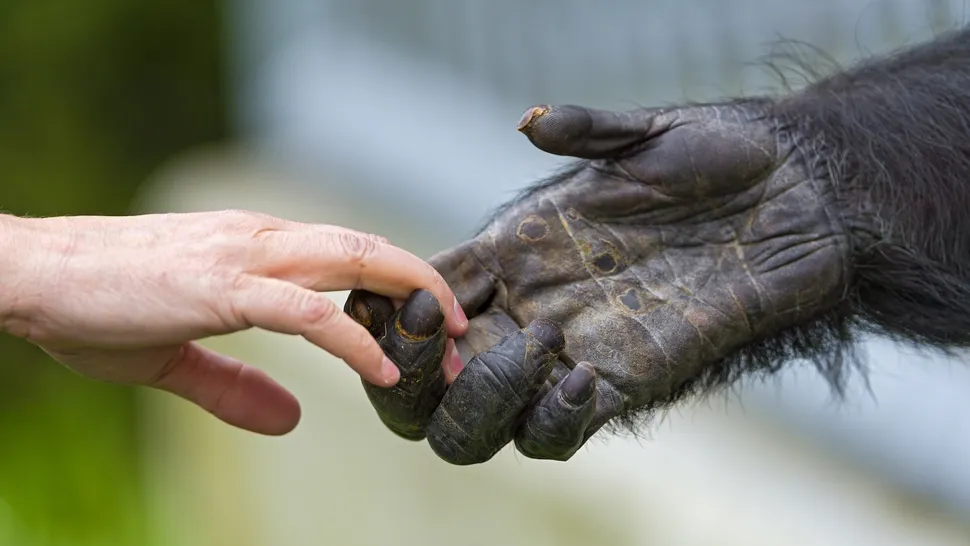
Tambako the Jaguar via Getty Images
Chimpanzees, along with bonobos, are humans’ closest living relatives. In fact, you may have heard that humans and chimps share 98.8% of their DNA. But is this actually true? And what does “similar DNA” actually mean? The truth is that the frequently cited 98.8% similarity between chimp (Pan troglodytes) and human (Homo sapiens) DNA overlooks key differences in the species’ genomes, experts told Live Science…….Continue reading….
By Clarissa Brincat
Source: Live Science
.
Critics:
The evolutionary history of primates can be traced back 65 million years. One of the oldest known primate-like mammal species, the Plesiadapis, came from North America; another, Archicebus, came from China. Other similar basal primates were widespread in Eurasia and Africa during the tropical conditions of the Paleocene and Eocene.

David R. Begun concluded that early primates flourished in Eurasia and that a lineage leading to the African apes and humans, including to Dryopithecus, migrated south from Europe or Western Asia into Africa. The surviving tropical population of primates—which is seen most completely in the Upper Eocene and lowermost Oligocene fossil beds of the Faiyum depression southwest of Cairo.
It gave rise to all extant primate species, including the lemurs of Madagascar, lorises of Southeast Asia, galagos or “bush babies” of Africa, and to the anthropoids, which are the Platyrrhines or New World monkeys, the Catarrhines or Old World monkeys, and the great apes, including humans and other hominids. The earliest known catarrhine is Kamoyapithecus from the uppermost Oligocene at Eragaleit in the northern Great Rift Valley in Kenya, dated to 24 million years ago.
Its ancestry is thought to be species related to Aegyptopithecus, Propliopithecus, and Parapithecus from the Faiyum, at around 35 mya. In 2010, Saadanius was described as a close relative of the last common ancestor of the crown catarrhines, and tentatively dated to 29–28 mya, helping to fill an 11-million-year gap in the fossil record. In the Early Miocene, about 22 million years ago, the many kinds of arboreally-adapted (tree-dwelling) primitive catarrhines from East Africa suggest a long history of prior diversification.
Fossils at 20 million years ago include fragments attributed to Victoriapithecus, the earliest Old World monkey. Among the genera thought to be in the ape lineage leading up to 13 million years ago are Proconsul, Rangwapithecus, Dendropithecus, Limnopithecus, Nacholapithecus, Equatorius, Nyanzapithecus, Afropithecus, Heliopithecus, and Kenyapithecus, all from East Africa. The presence of other generalized non-cercopithecids of Middle Miocene from sites far distant
Such as Otavipithecus from cave deposits in Namibia, and Pierolapithecus and Dryopithecus from France, Spain and Austria, is evidence of a wide diversity of forms across Africa and the Mediterranean basin during the relatively warm and equable climatic regimes of the Early and Middle Miocene.
The youngest of the Miocene hominoids, Oreopithecus, is from coal beds in Italy that have been dated to 9 million years ago. Molecular evidence indicates that the lineage of gibbons diverged from the line of great apes some 18–12 mya, and that of orangutans (subfamily Ponginae) diverged from the other great apes at about 12 million years; there are no fossils that clearly document the ancestry of gibbons, which may have originated in a so-far-unknown Southeast Asian hominoid population, but fossil proto-orangutans may be represented by Sivapithecus from India and Griphopithecus from Turkey, dated to around 10 mya.

Hominidae subfamily Homininae (African hominids) diverged from Ponginae (orangutans) about 14 mya. Hominins (including humans and the Australopithecine and Panina subtribes) parted from the Gorillini tribe (gorillas) between 8 and 9 mya; Australopithecine (including the extinct biped ancestors of humans) separated from the Pan genus (containing chimpanzees and bonobos) 4–7 mya. The Homo genus is evidenced by the appearance of H. habilis over 2 mya, while anatomically modern humans emerged in Africa approximately 300,000 years ago.
Species close to the last common ancestor of gorillas, chimpanzees and humans may be represented by Nakalipithecus fossils found in Kenya and Ouranopithecus found in Greece. Molecular evidence suggests that between 8 and 4 million years ago, first the gorillas, and then the chimpanzees (genus Pan) split off from the line leading to the humans.
Human DNA is approximately 98.4% identical to that of chimpanzees when comparing single nucleotide polymorphisms (see human evolutionary genetics). The fossil record, however, of gorillas and chimpanzees is limited; both poor preservation – rain forest soils tend to be acidic and dissolve bone – and sampling bias probably contribute to this problem.
Other hominins probably adapted to the drier environments outside the equatorial belt; and there they encountered antelope, hyenas, dogs, pigs, elephants, horses, and others. The equatorial belt contracted after about 8 million years ago, and there is very little fossil evidence for the split—thought to have occurred around that time—of the hominin lineage from the lineages of gorillas and chimpanzees.
The earliest fossils argued by some to belong to the human lineage are Sahelanthropus tchadensis (7 Ma) and Orrorin tugenensis (6 Ma), followed by Ardipithecus (5.5–4.4 Ma), with species Ar. kadabba and Ar. ramidus. It has been argued in a study of the life history of Ar. ramidus that the species provides evidence for a suite of anatomical and behavioral adaptations in very early hominins unlike any species of extant great ape.This study demonstrated affinities between the skull morphology of
Ar. ramidus and that of infant and juvenile chimpanzees, suggesting the species evolved a juvenalised or paedomorphic craniofacial morphology via heterochronic dissociation of growth trajectories. It was also argued that the species provides support for the notion that very early hominins, akin to bonobos (Pan paniscus) the less aggressive species of the genus Pan, may have evolved via the process of self-domestication
Consequently, arguing against the so-called “chimpanzee referential model” the authors suggest it is no longer tenable to use chimpanzee (Pan troglodytes) social and mating behaviors in models of early hominin social evolution. When commenting on the absence of aggressive canine morphology in Ar. ramidus and the implications this has for the evolution of hominin social psychology, they wrote.

The authors argue that many of the basic human adaptations evolved in the ancient forest and woodland ecosystems of late Miocene and early Pliocene Africa. Consequently, they argue that humans may not represent evolution from a chimpanzee-like ancestor as has traditionally been supposed. This suggests many modern human adaptations represent phylogenetically deep traits and that the behavior and morphology of chimpanzees may have evolved subsequent to the split with the common ancestor they share with humans.
The earliest documented representative of the genus Homo is Homo habilis, which evolved around 2.8 million years ago,Indis arguably the earliest species for which there is positive evidence of the use of stone tools. The brains of these early hominins were about the same size as that of a chimpanzee, although it has been suggested that this was the time in which the human SRGAP2 gene doubled, producing a more rapid wiring of the frontal cortex.
During the next million years a process of rapid encephalization occurred, and with the arrival of Homo erectus and Homo ergaster in the fossil record, cranial capacity had doubled to 850 cm3. (Such an increase in human brain size is equivalent to each generation having 125,000 more neurons than their parents.) It is believed that H. erectus and H. ergaster were the first to use fire and complex tools, and were the first of the hominin line to leave Africa, spreading throughout Africa, Asia, and Europe between 1.3 to 1.8 million years ago.
According to the recent African origin theory, modern humans evolved in Africa possibly from H. heidelbergensis, H. rhodesiensis or H. antecessor and migrated out of the continent some 50,000 to 100,000 years ago, gradually replacing local populations of H. erectus, Denisova hominins, H. floresiensis, H. luzonensis and H. neanderthalensis, whose ancestors had left Africa in earlier migrations. Archaic Homo sapiens, the forerunner of anatomically modern humans, evolved in the Middle Paleolithic between 400,000 and 250,000 years ago.
Recent DNA evidence suggests that several haplotypes of Neanderthal origin are present among all non-African populations, and Neanderthals and other hominins, such as Denisovans, may have contributed up to 6% of their genome to present-day humans, suggestive of a limited interbreeding between these species. According to some anthropologists, the transition to behavioral modernity with the development of symbolic culture, language, and specialized lithic technology happened around 50,000 years ago (beginning of the Upper Paleolithic), although others point to evidence of a gradual change over a longer time span during the Middle Paleolithic.
Homo sapiens is the only extant species of its genus, Homo. While some (extinct) Homo species might have been ancestors of Homo sapiens, many, perhaps most, were likely “cousins”, having speciated away from the ancestral hominin line. There is yet no consensus as to which of these groups should be considered a separate species and which should be subspecies; this may be due to the dearth of fossils or to the slight differences used to classify species in the genus Homo.
The Sahara pump theory (describing an occasionally passable “wet” Sahara desert) provides one possible explanation of the intermittent migration and speciation in the genus Homo. Based on archaeological and paleontological evidence, it has been possible to infer, to some extent, the ancient dietary practices of various Homo species and to study the role of diet in physical and behavioral evolution within Homo.

Some anthropologists and archaeologists subscribe to the Toba catastrophe theory, which posits that the supereruption of Lake Toba on Sumatran island in Indonesia some 70,000 years ago caused global starvation,[57] killing the majority of humans and creating a population bottleneck that affected the genetic inheritance of all humans today.
The genetic and archaeological evidence for this remains in question however. A 2023 genetic study suggests that a similar human population bottleneck of between 1,000 and 100,000 survivors occurred “around 930,000 and 813,000 years ago … lasted for about 117,000 years and brought human ancestors close to extinction.
Professor Lisa DikomitisUniversity of Kent 11:07 Wed, 08 May Review: Secrets of the NeanderthalsCommon Sense Media 00:01 Tue, 07 May
The art of the beeOUPblog 15:50 Mon, 06 May
Ayşegül Savaş’s Quest for HomePublishers Weekly 02:47 Sat, 04 May
Alex Hooper obituaryYahoo! UK & Ireland 18:59 Fri, 03 May
.
labels: #HumansAndChimps #Chimpanzee #GreatApes #HumanEvolution #AnimalBehavior #PrimateResearch #WildlifeConservation #NatureDocumentary #AnimalIntelligence #PrimateStudies #ChimpanzeeBehavior #HumansVsChimps #Biodiversity #EvolutionaryBiology #AnimalKingdom #ScienceEducation #Zoology #UnderstandAnimals #ConservationAwareness
AnimalBehavior, AnimalIntelligence, AnimalKingdom, biodiversity, chimpanzee, ChimpanzeeBehavior, ConservationAwareness, dna, evolutionarybiology, GreatApes, humanevolution, HumansAndChimps, HumansVsChimps, NatureDocumentary, PrimateResearch, PrimateStudies, ScienceEducation, UnderstandAnimals, WildlifeConservation 







Leave a Reply