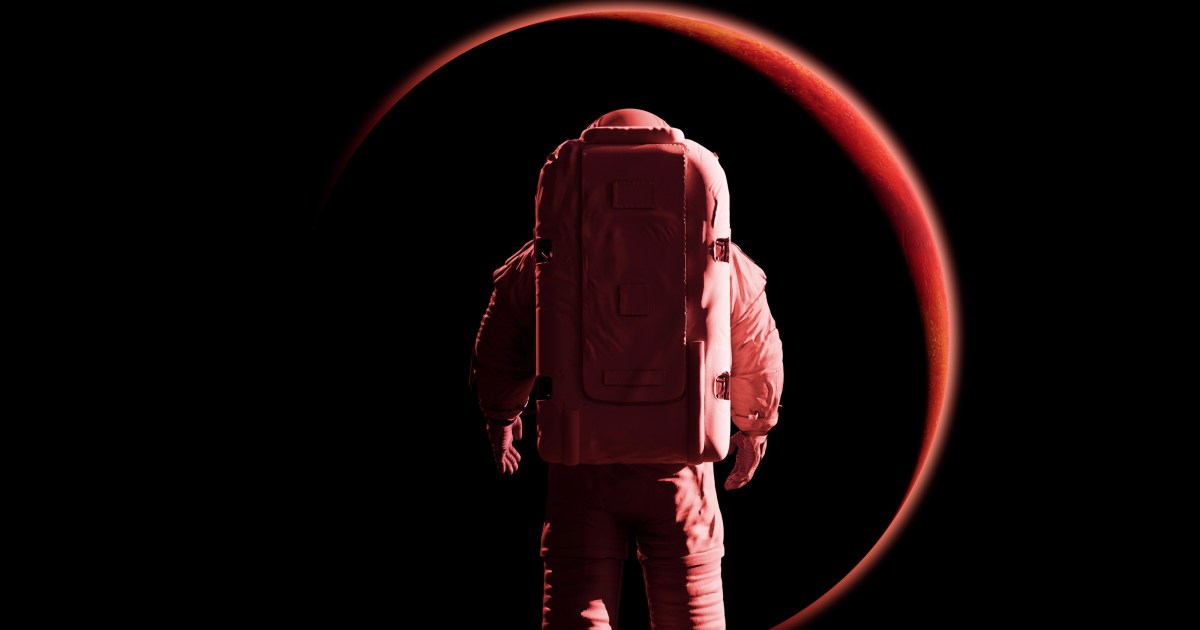
What if humanity isn’t just a flicker in the Universe but a force that could one day shape the cosmos itself? Physicist Brian Cox explores the possibility that we’re standing at the edge of a new era: The dawn of a spacefaring civilization. From reusable rockets and asteroid mining to the philosophy of our cosmic significance, Cox imagines how we might continue to explore the frontier of space. As we industrialize low Earth orbit and contemplate colonizing the Moon and Mars, who decides how space is governed?……Continue reading….
Source: Big Think
.
Critics:
Mars is a terrestrial planet with a surface that consists of minerals containing silicon and oxygen, metals, and other elements that typically make up rock. The Martian surface is primarily composed of tholeiitic basalt, although parts are more silica-rich than typical basalt and may be similar to andesitic rocks on Earth, or silica glass. Regions of low albedo suggest concentrations of plagioclase feldspar, with northern low albedo regions displaying higher than normal concentrations of sheet silicates and high-silicon glass.
Parts of the southern highlands include detectable amounts of high-calcium pyroxenes. Localized concentrations of hematite and olivine have been found. Much of the surface is deeply covered by finely grained iron(III) oxide dust. Although Mars has no evidence of a structured global magnetic field, observations show that parts of the planet’s crust have been magnetized, suggesting that alternating polarity reversals of its dipole field have occurred in the past. This paleomagnetism of magnetically susceptible minerals is similar to the alternating bands found on Earth’s ocean floors.

One hypothesis, published in 1999 and re-examined in October 2005 (with the help of the Mars Global Surveyor), is that these bands suggest plate tectonic activity on Mars four billion years ago, before the planetary dynamo ceased to function and the planet’s magnetic field faded. The Phoenix lander returned data showing Martian soil to be slightly alkaline and containing elements such as magnesium, sodium, potassium and chlorine. These nutrients are found in soils on Earth.
They are necessary for growth of plants. Experiments performed by the lander showed that the Martian soil has a basic pH of 7.7, and contains 0.6% perchlorate by weight, concentrations that are toxic to humans. Streaks are common across Mars and new ones appear frequently on steep slopes of craters, troughs, and valleys. The streaks are dark at first and get lighter with age. The streaks can start in a tiny area, then spread out for hundreds of metres.
They have been seen to follow the edges of boulders and other obstacles in their path. The commonly accepted hypotheses include that they are dark underlying layers of soil revealed after avalanches of bright dust or dust devils. Several other explanations have been put forward, including those that involve water or even the growth of organisms. Environmental radiation levels on the surface are on average 0.64 millisieverts of radiation per day, and significantly less than the radiation of 1.84 millisieverts per day or 22 millirads per day during the flight to and from Mars.
For comparison the radiation levels in low Earth orbit, where Earth’s space stations orbit, are around 0.5 millisieverts of radiation per day. Hellas Planitia has the lowest surface radiation at about 0.342 millisieverts per day, featuring lava tubes southwest of Hadriacus Mons with potentially levels as low as 0.064 millisieverts per day, comparable to radiation levels during flights on Earth.The vast upland region Tharsis contains several massive volcanoes, which include the shield volcano Olympus Mons.
The edifice is over 600 km (370 mi) wide. Because the mountain is so large, with complex structure at its edges, giving a definite height to it is difficult. Its local relief, from the foot of the cliffs which form its northwest margin to its peak, is over 21 km (13 mi), a little over twice the height of Mauna Kea as measured from its base on the ocean floor. The total elevation change from the plains of Amazonis Planitia, over 1,000 km (620 mi) to the northwest, to the summit approaches 26 km (16 mi), roughly three times the height of Mount Everest, which in comparison stands at just over 8.8 kilometres (5.5 mi).
Consequently, Olympus Mons is either the tallest or second-tallest mountain in the Solar System; the only known mountain which might be taller is the Rheasilvia peak on the asteroid Vesta, at 20–25 km (12–16 mi). The dichotomy of Martian topography is striking: northern plains flattened by lava flows contrast with the southern highlands, pitted and cratered by ancient impacts. It is possible that, four billion years ago, the Northern Hemisphere of Mars was struck by an object one-tenth to two-thirds the size of Earth’s Moon.
If this is the case, the Northern Hemisphere of Mars would be the site of an impact crater 10,600 by 8,500 kilometres (6,600 by 5,300 mi) in size, or roughly the area of Europe, Asia, and Australia combined, surpassing Utopia Planitia and the Moon’s South Pole–Aitken basin as the largest impact crater in the Solar System. Mars is scarred by a number of impact craters: a total of 43,000 observed craters with a diameter of 5 kilometres (3.1 mi) or greater have been found.
The largest exposed crater is Hellas, which is 2,300 kilometres (1,400 mi) wide and 7,000 metres (23,000 ft) deep, and is a light albedo feature clearly visible from Earth. There are other notable impact features, such as Argyre, which is around 1,800 kilometres (1,100 mi) in diameter,[101] and Isidis, which is around 1,500 kilometres (930 mi) in diameter. Due to the smaller mass and size of Mars, the probability of an object colliding with the planet is about half that of Earth.
Mars is located closer to the asteroid belt, so it has an increased chance of being struck by materials from that source. Mars is more likely to be struck by short-period comets, i.e., those that lie within the orbit of Jupiter.Martian craters can have a morphology that suggests the ground became wet after the meteor impact. The large canyon, Valles Marineris (Latin for “Mariner Valleys”, also known as Agathodaemon in the old canal maps), has a length of 4,000 kilometres (2,500 mi) and a depth of up to 7 kilometres (4.3 mi).
The length of Valles Marineris is equivalent to the length of Europe and extends across one-fifth the circumference of Mars. By comparison, the Grand Canyon on Earth is only 446 kilometres (277 mi) long and nearly 2 kilometres (1.2 mi) deep. Valles Marineris was formed due to the swelling of the Tharsis area, which caused the crust in the area of Valles Marineris to collapse. In 2012, it was proposed that Valles Marineris is not just a graben, but a plate boundary where 150 kilometres (93 mi) of transverse motion has occurred, making Mars a planet with possibly a two-tectonic plate arrangement.
Images from the Thermal Emission Imaging System (THEMIS) aboard NASA’s Mars Odyssey orbiter have revealed seven possible cave entrances on the flanks of the volcano Arsia Mons. The caves, named after loved ones of their discoverers, are collectively known as the “seven sisters”. Cave entrances measure from 100 to 252 metres (328 to 827 ft) wide and they are estimated to be at least 73 to 96 metres (240 to 315 ft) deep. Because light does not reach the floor of most of the caves, they may extend much deeper than these lower estimates and widen below the surface.
“Dena” is the only exception; its floor is visible and was measured to be 130 metres (430 ft) deep. The interiors of these caverns may be protected from micrometeoroids, UV radiation, solar flares and high energy particles that bombard the planet’s surface. Mars has seasons, alternating between its northern and southern hemispheres, similar to on Earth. Additionally the orbit of Mars has, compared to Earth’s, a large eccentricity and approaches perihelion when it is summer in its southern hemisphere and winter in its northern, and aphelion when it is winter in its southern hemisphere and summer in its northern.
As a result, the seasons in its southern hemisphere are more extreme and the seasons in its northern are milder than would otherwise be the case. The summer temperatures in the south can be warmer than the equivalent summer temperatures in the north by up to 30 °C (54 °F). Martian surface temperatures vary from lows of about −110 °C (−166 °F) to highs of up to 35 °C (95 °F) in equatorial summer.
The wide range in temperatures is due to the thin atmosphere which cannot store much solar heat, the low atmospheric pressure (about 1% that of the atmosphere of Earth), and the low thermal inertia of Martian soil.The planet is 1.52 times as far from the Sun as Earth, resulting in just 43% of the amount of sunlight. Mars has the largest dust storms in the Solar System, reaching speeds of over 160 km/h (100 mph). These can vary from a storm over a small area, to gigantic storms that cover the entire planet.
They tend to occur when Mars is closest to the Sun, and have been shown to increase global temperature. Seasons also produce dry ice covering polar ice caps. While Mars contains water in larger amounts, most of it is dust covered water ice at the Martian polar ice caps. The volume of water ice in the south polar ice cap, if melted, would be enough to cover most of the surface of the planet with a depth of 11 metres (36 ft).
Water in its liquid form cannot prevail on the surface of Mars due to the low atmospheric pressure on Mars, which is less than 1% that of Earth,[147] only at the lowest of elevations pressure and temperature is high enough for water being able to be liquid for short periods. Water in the atmosphere is small, but enough to produce larger clouds of water ice and different cases of snow and frost, often mixed with snow of carbon dioxide dry ice.
AI for Earth: How NASA’s Artificial Intelligence and Open Science Efforts Combat Climate Change ASDNews 11:40 Fri, 19 Apr
.
EarthsOrbit ,SpaceExploration ,Astronomy ,CosmicJourney ,OrbitScience ,PlanetaryMotion ,SpaceEducation ,CelestialBodies ,OurPlanet ,StellarWonders ,Gravity ,Universe ,LearnAboutSpace ,Astrophysics ,OrbitStudy ,SolarSystem ,SpaceFacts ,ScienceCommunity ,AstroPhotography ,AstronomicalScience







Leave a Reply