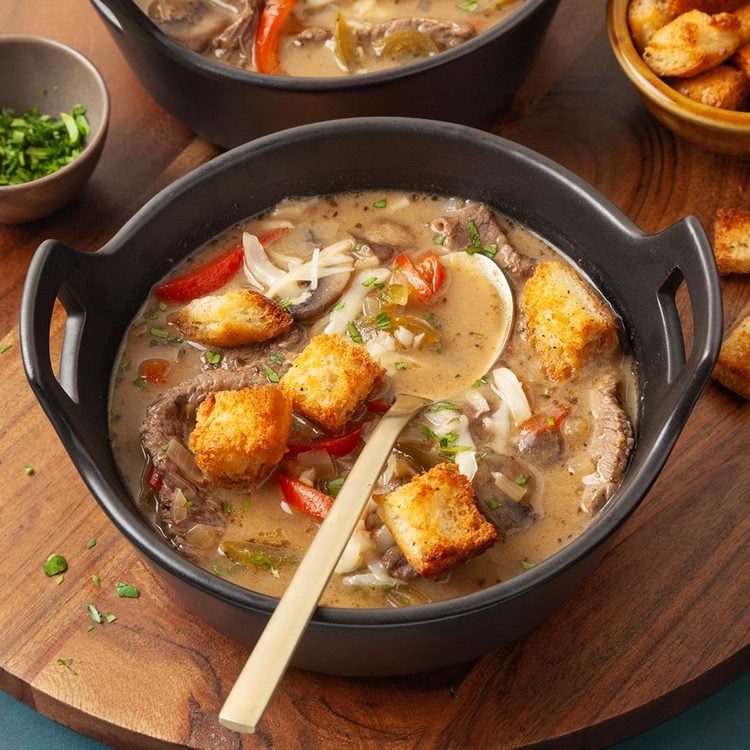
Sure, Philadelphia has the Liberty Bell, Rocky Balboa and, uh, Gritty. But when it comes to famous Philadelphia things, it doesn’t get any more iconic than the Philly cheesesteak sandwich. This classic sandwich is a mouthwatering combination of thinly sliced steak, onions and cheese served on a hoagie roll that’s crisp on the outside and soft on the inside. Given its iconic status, the sandwich has inspired countless recipes, including tailgate-ready Philly cheesesteak sliders and party-perfect Philly cheesesteak dip…..…Continue reading….
By: Susan Bronson
Source: Taste Of Home
.
Critics:
In the western cuisine of the twentieth and twenty-first centuries there have been and are numerous soups. Auguste Escoffier divided them into two main types:
- Clear soups, which include plain and garnished consommés
- Thick soups, which comprise the purées, veloutés, and creams
He added, “A third class, which is independent of either of the above, in that it forms part of plain, household cookery, embraces vegetable soups and garbures or gratinéd soups. But in important dinners – by this I mean rich dinners – only the first two classes are recognised”.

Louis Saulnier’s Le Répertoire de la cuisine, first published in 1914, contains six pages of details of potages (clear soups), two pages on soupes (moistened with water, milk or thin white stock), eight pages on veloutés (soups thickened with egg yolks) and crèmes (thickened with double cream), as well as a further three pages on fifty-three “Potages étrangers” – foreign soups – including borscht from the Russian Empire, clam chowder from the United States, cock-a-leekie from Scotland, minestrone from Italy, mock turtle from England, and mulligatawny from British India.
The French distinction between clear and thick soups is echoed in other languages: in German Klare Suppen and Gebundene Suppen; in Italian Brodi and Zuppe; and in Spanish Sopas claras and Sopas spessas.[Many soups are fundamentally the same in the cuisines of various countries, with minor local variations.
Oxtail soup, a familiar item in British and American cooking, is one of several oxtail soups from round the world, including one from Sichuan, others from Austria (Ochsenschleppsuppe), Jamaica, South Africa and France (potage bergére – oxtail consommé thickened with tapioca, garnished with asparagus and diced mushrooms). Chicken soups have been common to numerous cuisines since ancient times: they featured in east Asian cooking more than 5,000 years ago, and were considered therapeutic in pharaonic Egypt, the Roman empire, Persia .
Modern variants are found from Japan (tori no suimono) to Portugal (canja), Colombia (ajiaco) and France (consommé de volaille). Elizabeth David comments in French Provincial Cooking (1960), “No doubt because the tin and the package have become so universal, people are astonished by the true flavours of a well-balanced home-made soup and demand more helpings if only to make sure that their noses and palates are not deceiving them”. In their Mastering the Art of French Cooking (1961), Simone Beck, Louisette Bertholle and Julia Child write:
A good home-made soup in these days of the tin opener is almost a unique and always a satisfying experience. Most soups are uncomplicated to make, and the major portion of them can be prepared several hours before serving. Cold soups are a particular variation on the traditional soup. Two well-known chilled soups are the Franco-American vichyssoise and the Spanish gazpacho.
The Oxford English Dictionary defines the former as “A soup made with potatoes, leeks, and cream, usually served chilled”, and the latter as “A cold Spanish vegetable soup consisting of onions, cucumbers, pimentos, etc., chopped very small with bread and put into a bowl of oil, vinegar, and water”. Many ancient cuisines developed versions of fruit soup: either fruits were added to a grain-based pottage or the soup consisted mostly of fruit flavoured with various spices.
The soups were made from whatever fruit was ready for harvest locally or from dried fruit. Fruit soups remain well known in Germany and Nordic countries: although they may sometimes be served at the beginning of a meal they are sweet dishes. Davidson instances rødgrød, also known as rote Grütze, a red berry soup popular in Denmark, other parts of Scandinavia and Germany, sitruunakeitto, a creamy lemon soup from Finland, and the Middle Eastern khoshab, made with dried fruits.
Other fruits used to make sweet soups include apples, blueberries, cherries, gooseberries, rhubarb and rose-hips. Davidson mentions a category, “sour soups”, important in northern, eastern and central Europe. Some have a fermented beer base or use Sauerkraut, others are soured with vinegar, pickled beetroot, lemon or yoghurt. Examples include sinisang (above), chorba, a meat and vegetable soup found in many countries of eastern Europe, north Africa and Asia, and sop ikan pedas, a fish soup from Indonesia.
Żurek, from Poland, is a sour bread soup based not on meat or vegetable stock but on fermented cereal such as rye. According to a Polish cookery book, “it is always sour, salty, and creamy at the same time” Cold soups are a particular variation on the traditional soup. Two well-known chilled soups are the Franco-American vichyssoise and the Spanish gazpacho.
The Oxford English Dictionary defines the former as “A soup made with potatoes, leeks, and cream, usually served chilled”, and the latter as “A cold Spanish vegetable soup consisting of onions, cucumbers, pimentos, etc., chopped very small with bread and put into a bowl of oil, vinegar, and water”. Many ancient cuisines developed versions of fruit soup: either fruits were added to a grain-based pottage or the soup consisted mostly of fruit flavoured with various spices.
The soups were made from whatever fruit was ready for harvest locally or from dried fruit. Fruit soups remain well known in Germany and Nordic countries: although they may sometimes be served at the beginning of a meal they are sweet dishes. Davidson instances rødgrød, also known as rote Grütze, a red berry soup popular in Denmark, other parts of Scandinavia and Germany, sitruunakeitto, a creamy lemon soup from Finland, and the Middle Eastern khoshab, made with dried fruits.
Other fruits used to make sweet soups include apples, blueberries, cherries, gooseberries, rhubarb and rose-hips. Davidson mentions a category, “sour soups”, important in northern, eastern and central Europe. Some have a fermented beer base or use Sauerkraut, others are soured with vinegar, pickled beetroot, lemon or yoghurt. Examples include sinisang (above), chorba, a meat and vegetable soup found in many countries of eastern Europe, north Africa and Asia, and sop ikan pedas, a fish soup from Indonesia.
Merle Bernedoodle Puppy’s Perfect Pink Toe Beans Are Breaking the Internet Again19:45
.
SoupRecipe ,HealthySoup ,ComfortFood ,EasyRecipes ,CookingAtHome ,HomemadeSoup ,CozyMeals ,RecipeOfTheDay ,Foodie ,DeliciousSoup ,Yummy ,WinterCooking ,QuickRecipes ,VegetableSoup ,SoupLovers ,CookingTips ,MealPrep ,GlutenFree ,VeganSoup ,HomeCooking








Leave a Reply