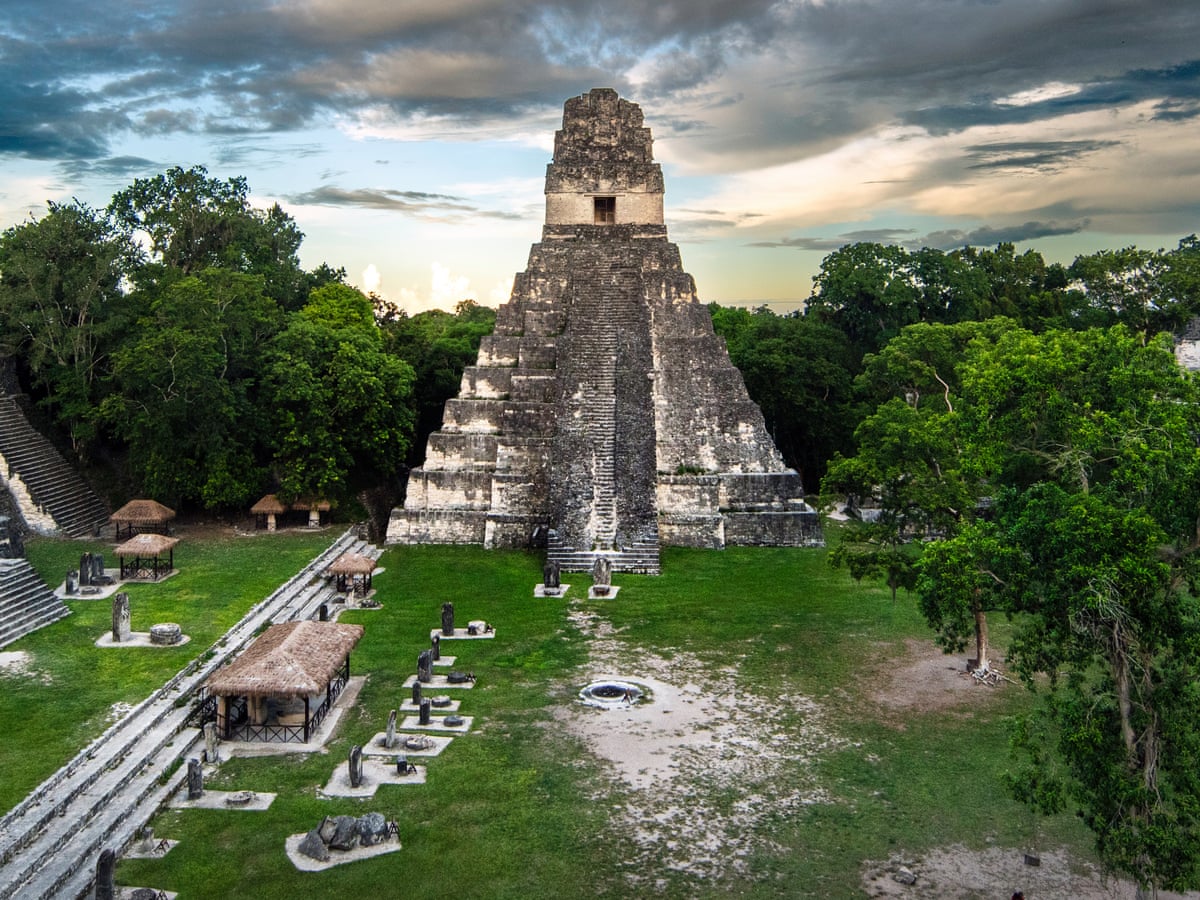
As a seven-year-old, Francisco Estrada-Belli was afraid all of history would have been discovered by the time he was old enough to contribute. The year was 1970 and he and his parents had come from Rome to visit relatives in the Central American country of Guatemala. On the trip, they visited the ancient Maya ruins at Tikal. “I was completely mesmerised,” Estrada-Belli told me recently. “It was jungle everywhere, there were animals, and then these enormous, majestic temples. I asked questions but felt the answers were not good enough. I decided there and then that I wanted to be answering them.”……….Continue reading….
By : Marcus Haraldsson
Source: The Guardian
.
“Maya” is a modern term used to refer collectively to the various peoples that inhabited this area, as Maya peoples have not had a sense of a common ethnic identity or political unity for the vast majority of their history. Early Spanish and Mayan-language colonial sources in the Yucatán Peninsula used the term “Maya” to denote both the language spoken by the Yucatec Maya and the area surrounding the then-abandoned city of Mayapán.

The term “Maya” was derived from the city of Mayapán. Some colonial Mayan-language sources also used “Maya” to refer to other Maya groups, sometimes pejoratively in reference to Maya groups more resistant to Spanish rule. The Maya civilization occupied a wide territory that included southeastern Mexico and northern Central America.
This area included the entire Yucatán Peninsula and all of the territory now in the modern countries of Guatemala and Belize, as well as the western portions of Honduras and El Salvador. Most of the peninsula is formed by a vast plain with few hills or mountains and a generally low coastline. The territory of the Maya covered a third of Mesoamerica and the Maya were engaged in a dynamic relationship with neighbouring cultures that included the Olmecs, Mixtecs, Teotihuacan, and Aztecs.
During the Early Classic period, the Maya cities of Tikal and Kaminaljuyu were key Maya foci in a network that extended into the highlands of central Mexico; there was a strong Maya presence at the Tetitla compound of Teotihuacan. The Maya city of Chichen Itza and the distant Toltec capital of Tula had an especially close relationship. The Petén region consists of densely forested low-lying limestone plain; a chain of fourteen lakes runs across the central drainage basin of Petén.
To the south the plain gradually rises towards the Guatemalan Highlands. The dense Maya forest covers northern Petén and Belize, most of Quintana Roo, southern Campeche, and a portion of the south of Yucatán state. Farther north, the vegetation turns to lower forest consisting of dense scrub. The littoral zone of Soconusco lies to the south of the Sierra Madre de Chiapas, and consists of a narrow coastal plain and the foothills of the Sierra Madre.
The Maya highlands extend eastwards from Chiapas into Guatemala, reaching their highest in the Sierra de los Cuchumatanes. Their major pre-Columbian population centres were in the largest highland valleys, such as the Valley of Guatemala and the Quetzaltenango Valley. In the southern highlands, a belt of volcanic cones runs parallel to the Pacific coast. The highlands extend northwards into Verapaz, and gradually descend to the east.The history of Maya civilization is divided into three principal periods: the Preclassic, Classic, and Postclassic.
These were preceded by the Archaic Period, during which the first settled villages and early developments in agriculture emerged. Modern scholars regard these periods as arbitrary divisions of Maya chronology, rather than indicative of cultural evolution or decline. Definitions of the start and end dates of period spans can vary by as much as a century, depending on the author.The Spanish conquest stripped away most of the defining features of Maya civilization.
However, many Maya villages remained remote from Spanish colonial authority, and for the most part continued to manage their own affairs. Maya communities and the nuclear family maintained their traditional day-to-day life. The basic Mesoamerican diet of maize and beans continued, although agricultural output was improved by the introduction of steel tools. Traditional crafts such as weaving, ceramics, and basketry continued to be practised.

Community markets and trade in local products continued long after the conquest. At times, the colonial administration encouraged the traditional economy in order to extract tribute in the form of ceramics or cotton textiles, although these were usually made to European specifications. Maya beliefs and language proved resistant to change, despite vigorous efforts by Catholic missionaries.
The 260-day tzolkʼin ritual calendar continues in use in modern Maya communities in the highlands of Guatemala and Chiapas, and millions of Mayan-language speakers inhabit the territory in which their ancestors developed their civilization. Commoners are estimated to have comprised over 90% of the population, but relatively little is known about them. Their houses were generally constructed from perishable materials, and their remains have left little trace in the archaeological record.
Some commoner dwellings were raised on low platforms, and these can be identified, but an unknown quantity of commoner houses were not. Such low-status dwellings can only be detected by extensive remote-sensing surveys of apparently empty terrain. The range of commoners was broad; it consisted of everyone not of noble birth, and therefore included everyone from the poorest farmers to wealthy craftsmen and commoners appointed to bureaucratic positions.
Commoners engaged in essential production activities, including that of products destined for use by the elite, such as cotton and cacao, as well as subsistence crops for their own use, and utilitarian items such as ceramics and stone tools. Commoners took part in warfare, and could advance socially by proving themselves as outstanding warriors. Commoners paid taxes to the elite in the form of staple goods such as maize, flour and game. It is likely that hard-working commoners who displayed exceptional skills and initiative could become influential members of Maya society.
How the Maya Built Their World: Energetics and Ancient Architecture. Austin: University of Texas Press.
“Radar mapping, Archaeology, and Ancient Maya Land Use”
Classic Maya Warfare and Weapons: Spear, dart, and arrow points of Aguateca and Copan”
Scientists discover ancient Mayan city hidden under Guatemalan jungle”.
Early Writing in Central Mexico: In Tlilli, In Tlapalli before A.D. 1000″.
Ancient Mesoamerica: A Comparison of Change in Three Regions. (ed.). “
Style and substance, or why the Cacaxtla paintings were buried”.
Relaciones de Verapaz y las Tierras Bajas Mayas Centrales en el siglo XVII”

Popul Vuh: Sacred Book of the Quiché Maya People”
Maya Palaces and Elite Residences: An interdisciplinary approach.
.
Labels: #MayaCivilization #MayaHistory #AncientMaya #MayaCulture #MayaArchitecture #MayaRuins #MesoamericanCivilization #Archaeology #CivilizationHistory #MayaArtifacts #AncientCivilizations #MayaArt #MayaReligion #HistoricalDiscovery #MayaSociety #MayaEngineering #MayaTemple #MayaLanguages #LearnMaya #Tikal #Guatemala



Leave a Reply