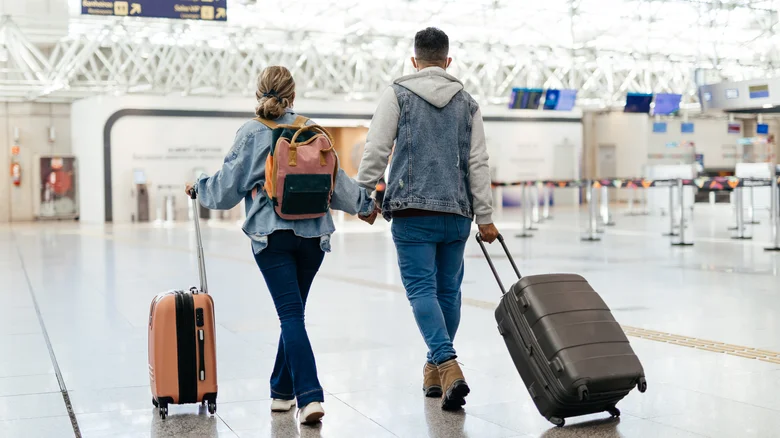
Credit: Igor Alecsander/Getty Images
Most airline passengers know that major misconduct on a plane, like physically assaulting a crew member, becoming severely intoxicated, or smoking and vaping in the bathroom, can quickly get a person removed from a specific flight or even permanently banned from an airline. However, there are also a surprising number of lesser-known actions that can result in a ban. Some of the issues we’ll look at here are fairly apparent in-air safety violations, but others fall into more of a gray area, involving things like attire, etiquette disputes, and behavior on the internet………Continue reading…
Source: Islands
.
Critics:
Travel class on an airplane is usually split into a two, three or four class model service. U.S. domestic flights usually have two classes: economy class and a domestic first class partitioned into cabins. International flights may have up to four classes: economy class; premium economy; business class or club class; and first class. Most air travel starts and ends at a commercial airport.
The typical procedure is check-in; border control; airport security baggage and passenger check before entering the gate; boarding; flying; and pick-up of luggage and – limited to international flights – another border control at the host country’s border. Most passengers must go through these steps when flying with a commercial airline.

For longer journeys, air travel may consist of several flights with a layover in between. The number of layovers often depends on the number of hub airports the journey is routed through. Airlines rely either on the point-to-point model or the spoke-and-hub model to operate flights in between airports. The point-to-point model, often used by low-cost carriers such as Southwest, relies on scheduling flights directly between destination airports.
The spoke-and-hub model, used by carriers such as American and Delta, as well as international airlines like Emirates and Qatar Airways, relies on scheduling flights to and from major global hub airports. The hub-and-spoke model allows airlines to connect more destinations and provide more frequent routes, while the point-to-point system allows airlines to avoid layovers and have more cost effective operations.
Modern aircraft consume less fuel per person and mile traveled than cars when fully booked. However, the distances traveled are often significantly larger and will not replace car travel but instead add to it, and not every flight is booked out. Instead, the scheduled flights are predominant, resulting in a far worse fuel efficiency. According to the ATAG, flights produced 781 million tonnes (769 million long tons) of the greenhouse gas CO2 in 2015 globally, as compared to an estimated total of 36 billion tonnes (35 billion long tons) anthropogenic CO2.
Carbon offset is often proposed as solution to mitigate the CO2 emissions of flying. There are many NGOs that offer to compensate CO2 emissions by advancing clean renewable energy, reducing energy consumption and capturing already released carbon in trees or other plants. However, carbon offsetting is a very controversial topic as it only tries to mitigate what has already been emitted.
Modern air travel is significantly safer than road travel. In 2008 in the United States, there were 1.27 fatalities per 100 million road vehicle miles, compared to no fatalities and almost zero accidents per million flying miles. There were more than five million driving accidents, compared to 20 accidents in flying.Travelers may perceive planes to be more dangerous as they do not allow individual control and because plane crashes are more catastrophic events (the availability bias).
Deep vein thrombosis (DVT) is the third-most common vascular disease, next to stroke and heart attack. It is estimated that DVT affects one in 5,000 travelers on long flights. Risk increases with exposure to more flights within a short time frame and with increasing duration of flights.

AirTravelRules ,TravelTips ,TravelHacks ,FlyingSmart ,AviationAdvice ,TravelWithEase ,AirportGuidelines ,FlightSafety ,AirlineAdvice ,TravelSuccess ,FrequentFlyer ,PackingTips ,TravelPreparation ,OnboardEtiquette ,GlobalTravel ,TravelSmart ,Jetsetters ,TSAinspo ,Wanderlust


Leave a Reply