Showing posts with label SleepHygiene. Show all posts

Monday, November 23, 2026

The 14 Night Sleep Reset – Your Own Wellness Course On Better Sleep Plans

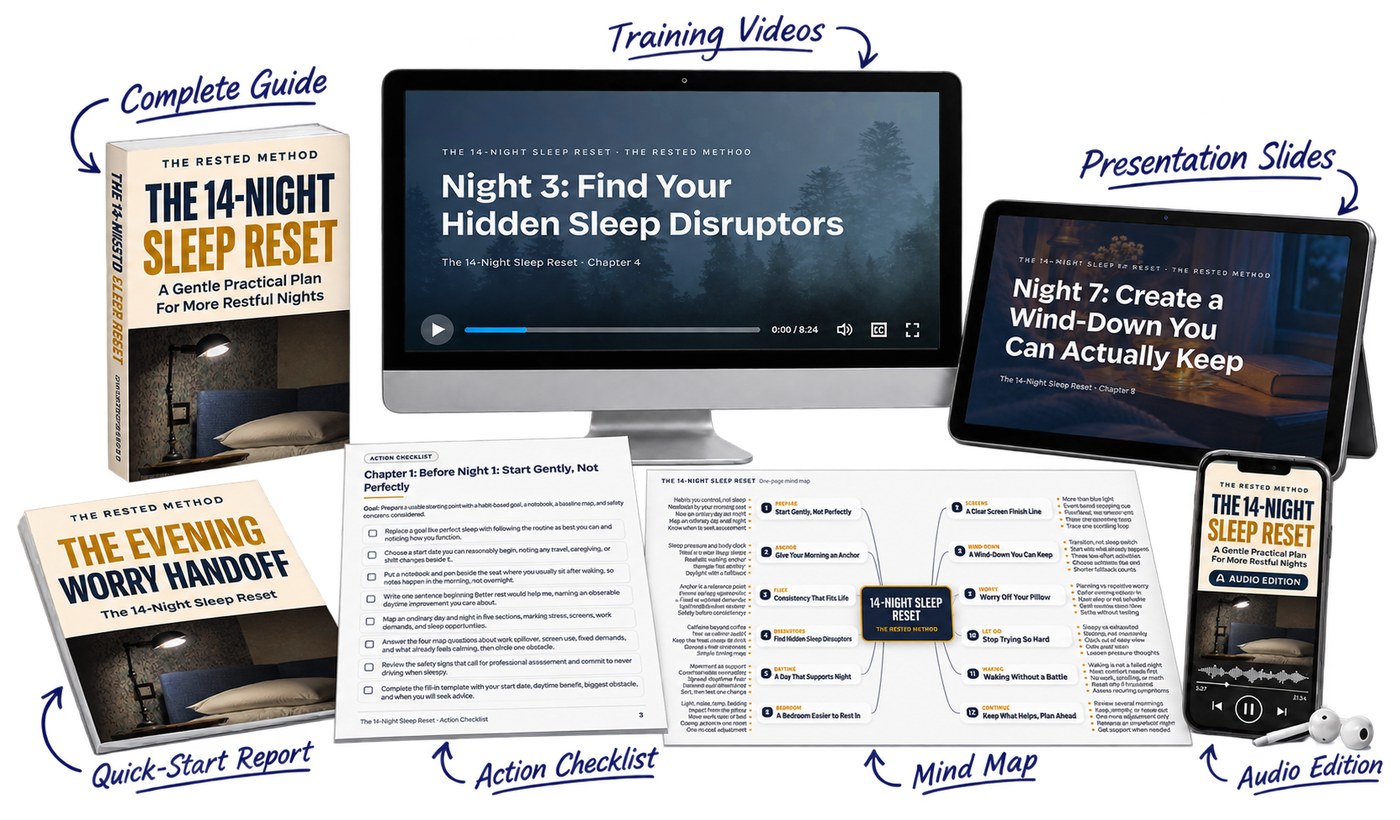
The 14-Night Sleep Reset package: guide, lead magnet report, training video and slides, checklist and mind map

Your Customers Get A Finished Course On Better Sleep Habits, Ready For Their Name. A 12-chapter guide, 12 narrated training videos, 12 MP3 lessons, 12 slide decks, a checklist, a mind map and a lead magnet report, all built around one method and sold with Private Label Rights. Seven finished modules, all built from the same book and the same method, plus the Private Label Rights license certificate.

Lying awake while the day replays. Checking the clock at 3 a.m. and doing sleep arithmetic. Trying one more gadget or strict rule and dropping it a week later. Millions of adults know the feeling, and many go looking for a gentle, practical way to rest better. That makes sleep an evergreen topic for anyone who sells wellness: it fits health, self-care, productivity, coaching and lifestyle audiences, and it never goes out of date.

Your customers do not get a pile of loose tips or a strict sleep boot camp. They get six gentle steps in a set order, introduced over fourteen nights, from the first morning cue to the last evening thought. Each chapter comes as pages in the guide, a narrated video, an MP3 lesson and a slide deck. Here is exactly what is inside. Set a goal that does not depend on tonight, see how the fourteen nights fit together, consider safety first and map an ordinary day and night without judging it.

Root Your Rhythm : Choose a realistic waking anchor and use daylight and daily routines to support a steadier sleep-wake rhythm.

Ease Daytime Friction : Adjust caffeine, alcohol, movement, meals and naps so daytime choices are less likely to interfere with nighttime rest.

Set Your Sleep Space : Make the bedroom and evening screen habits more supportive of sleep using simple changes rather than new purchases.

Turn Down The Day: Create a flexible wind-down that gives unfinished tasks, worries and physical tension somewhere to go before bed.

Exit the Sleep Struggle :Respond to wakefulness without forcing sleep, checking the clock or turning bed into a place for frustrated waiting.

Develop Your Next Rhythm : Review broad patterns, keep useful habits, adapt to disruptions and recognize when professional support is the next step.

Learn the two processes behind sleep timing, tell tired from sleepy, choose a realistic waking anchor and connect daylight to something you already do. Treat the anchor as a reference point rather than an order, plan for weekends, care duties and shift work, and write a fallback for disrupted days.Look at caffeine, alcohol and nicotine as timing questions, find a personal cutoff and keep the breaks you enjoy while changing what is in the cup.

Use movement as support, make evening eating and drinking comfortable, rethink naps and test one daytime adjustment with the sort-then-test worksheet. Judge the bedroom from the pillow, remove one irritation using what is already at home and give work and conflict somewhere else to happen. Go beyond blue light, separate being reachable from being available, trace one scrolling loop and choose a clear finish line for screens.

Build a three-part wind-down from things that already happen, choose activities that end easily and keep a shorter version for busy nights. Give unfinished thoughts a place to wait with an earlier-evening check-in, sort what can be acted on and let the body settle without testing it.See how effort keeps the struggle going, separate sleepy from exhausted and prepare a quiet reset that does not become another project.

Treat occasional waking as normal, recognize symptoms that deserve assessment and draw a simple response tree for frustrated nights. Review several mornings, change one remaining friction point, rehearse an imperfect night and choose a continuation plan for the next two weeks. A 117-page, 12-chapter guide of about 23,100 words that teaches the six-step RESTED Method over fourteen nights, from a gentle start before Night 1 to a plan for keeping what helps after Night 14.

Every chapter ends with a worksheet, a fill-in template, a checklist and a Key Takeaways box, so readers finish each night with something to try, not just something to think about.

Source: The 14-Night Sleep Reset

.

14NightSleepResetCourse ,onlinecourse ,NightSleep ,SleepReset ,SleepGuide ,SleepHygiene ,RestfulNight ,HealthySleep ,SleepWell ,GuideToSleep ,BedtimeRoutine ,SleepJourney ,RestorativeSleep ,SleepTips ,SereneNights ,BetterSleep ,SleepBook ,SleepScience, RelaxationTechniques ,DreamWell ,SleepGoals

Tuesday, September 22, 2026

Want Better Sleep? A Massive New Study of 14,689 People Says Avoid This Surprising Thing

Getty Images

Intense exercise in the evening can keep the body in a heightened state of alertness, which is why public health guidelines have previously advised against working out too close to bedtime,” said lead author Dr. Josh Leota, of the university’s School of Psychological Sciences. “However, findings from controlled laboratory studies are less conclusive, with many suggesting that evening exercise doesn’t necessarily disrupt sleep……..Continue reading….

By:  Bill Murphy JR

Source: INC

.

Critics:

The main symptom of sleep paralysis is being unable to move or speak during awakening. Imagined sounds such as humming, hissing, static, zapping and buzzing noises are reported during sleep paralysis. Other sounds such as voices, whispers and roars are also experienced. It has also been known that one may feel pressure on their chest and intense pain in their head during an episode.

These symptoms are usually accompanied by intense emotions such as fear and panic. People also have sensations of being dragged out of bed or of flying, numbness, and feelings of electric tingles or vibrations running through their body. Sleep paralysis may include hallucinations, such as an intruding presence or dark figure in the room, suffocating or the individual feeling a sense of terror, accompanied by a feeling of pressure on one’s chest and difficulty breathing.

The pathophysiology of sleep paralysis has not been concretely identified, although there are several theories about its cause. The first of these stems from the understanding that sleep paralysis is a parasomnia resulting from dysfunctional overlap of the REM and waking stages of sleep. Polysomnographic studies found that individuals who experience sleep paralysis have shorter REM sleep latencies than normal along with shortened NREM and REM sleep cycles, and fragmentation of REM sleep.

This study supports the observation that disturbance of regular sleeping patterns can precipitate an episode of sleep paralysis, because fragmentation of REM sleep commonly occurs when sleep patterns are disrupted and has now been seen in combination with sleep paralysis. Another major theory is that the neural functions that regulate sleep are out of balance in such a way that causes different sleep states to overlap.

In this case, cholinergic sleep “on” neural populations are hyperactivated and the serotonergic sleep “off” neural populations are under-activated. As a result, the cells capable of sending the signals that would allow for complete arousal from the sleep state, the serotonergic neural populations, have difficulty in overcoming the signals sent by the cells that keep the brain in the sleep state.

During normal REM sleep, the threshold for a stimulus to cause arousal is greatly elevated. Under normal conditions, medial and vestibular nuclei, cortical, thalamic, and cerebellar centers coordinate things such as head and eye movement, and orientation in space. In individuals reporting sleep paralysis, there is almost no blocking of exogenous stimuli, which means it is much easier for a stimulus to arouse the individual.

The vestibular nuclei in particular has been identified as being closely related to dreaming during the REM stage of sleep. According to this hypothesis, vestibular-motor disorientation, unlike hallucinations, arise from completely endogenous sources of stimuli. If the effects of sleep “on” neural populations cannot be counteracted, characteristics of REM sleep are retained upon awakening.

Common consequences of sleep paralysis include headaches, muscle pains or weakness or paranoia. As the correlation with REM sleep suggests, the paralysis is not complete: use of EOG traces shows that eye movement is still possible during such episodes; however, the individual experiencing sleep paralysis is unable to speak. Research has found a genetic component in sleep paralysis.

The characteristic fragmentation of REM sleep, hypnopompic, and hypnagogic hallucinations have a heritable component in other parasomnias, which lends credence to the idea that sleep paralysis is also genetic. Twin studies have shown that if one twin of a monozygotic pair (identical twins) experiences sleep paralysis that other twin is very likely to experience it as well. 

The identification of a genetic component means that there is some sort of disruption of a function at the physiological level. Further studies must be conducted to determine whether there is a mistake in the signaling pathway for arousal as suggested by the first theory presented, or whether the regulation of melatonin or the neural populations themselves have been disrupted.

Several types of hallucinations have been linked to sleep paralysis: the belief that there is an intruder in the room, the feeling of a presence, and the sensation of floating. One common hallucination is the presence of an Incubus. A neurological hypothesis is that in sleep paralysis the cerebellum, which usually coordinates body movement and provides information on body position, experiences a brief myoclonic spike in brain activity inducing a floating sensation.

The intruder and incubus hallucinations highly correlate with one another, and moderately correlated with the third hallucination, vestibular-motor disorientation, also known as out-of-body experiences, which differ from the other two in not involving the threat-activated vigilance system. Although the core features of sleep paralysis (e.g., atonia, a clear sensorium, and frequent hallucinations) appear to be universal, the ways in which they are experienced vary according to time, place, and culture.

Over 100 terms have been identified for these experiences.Some scientists have proposed sleep paralysis as an explanation for reports of paranormal and spiritual phenomena such as ghosts, alien visits, demons or demonic possession, alien abduction experiences, the night hag and shadow people haunting.

Study finds mindfulness and tai chi practices eased sleep problems, fatigue, and pain after cancer treatment 18:03 Thu, 17 Sep

Leave a Reply

Better Rotors, Higher Heights Thanks To NASA’s Dual Planet Presence

NASA/JPL-Caltech There aren’t any organizations other than NASA that can claim they are operating on two different planets (at least none we...